














Euskadi, Euskara on France Bleu, is almost always playing in the background when I work. I understand almost nothing, but I love the accent, the rhythm, and the nostalgia it brings me from the Pays Basque.
Today I discovered that there is no local Indigenous radio in Ottawa.
This invites a broader look at the history of broadcasting in Canada. For much of the twentieth century, Canadian radio was organized primarily through English- and French-language institutions, while Indigenous communities gradually built access to broadcasting capacity, licensing, infrastructure, and editorial space. As Indigenous broadcasting developed, radio became an important medium for local news, community announcements, music, oral tradition, and the public use of Indigenous languages in everyday life.
A major turning point came in the early 1980s, when Indigenous broadcasting received structured public support through initiatives such as the Northern Native Broadcast Access Program. That support helped create the conditions for stations and networks to grow across the country. It strengthened the role of radio as a public space for language transmission, cultural continuity, and community-based communication.
Several stations and networks became part of that history. CKRZ-FM in Ohsweken served Six Nations. Wawatay Radio played an important role in northern Ontario. NCI grew into a major Indigenous broadcaster in Manitoba. CFNR became one of the best-known Indigenous radio networks in British Columbia. In Ottawa, 95.7 ELMNT FM, launched by First Peoples Radio, brought Indigenous-focused music, talk, and community programming into a major urban centre.
In that context, National Indigenous Languages Day, on March 31st, highlights an important public question: how Indigenous languages live in everyday civic space. Radio has been one of the clearest ways to make a language audible in daily life through news, interviews, music, greetings, and community programming. The history of Indigenous broadcasting shows that language recognition becomes stronger when it is supported by regular, local, and public forms of communication.
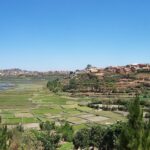
From my Malagasy background, this question also resonates historically. In Madagascar, as Laurent Andrianasolo shows in his study of Radio Madagascar during the First Republic, radio was used as a central instrument of cultural and linguistic nation-building, with standardized Merina becoming the main public language of broadcast through news, music, radio theatre, educational programming, and everyday announcements. The article makes clear that radio did more than entertain: it organized visibility, legitimacy, and repetition, giving one language and one cultural form a regular place in public life while other vernacular forms were more often framed as folklore. That history helps clarify why local radio matters so much in discussions of Indigenous languages: broadcasting is one of the institutions through which a language becomes audible, ordinary, and publicly recognized in daily life.
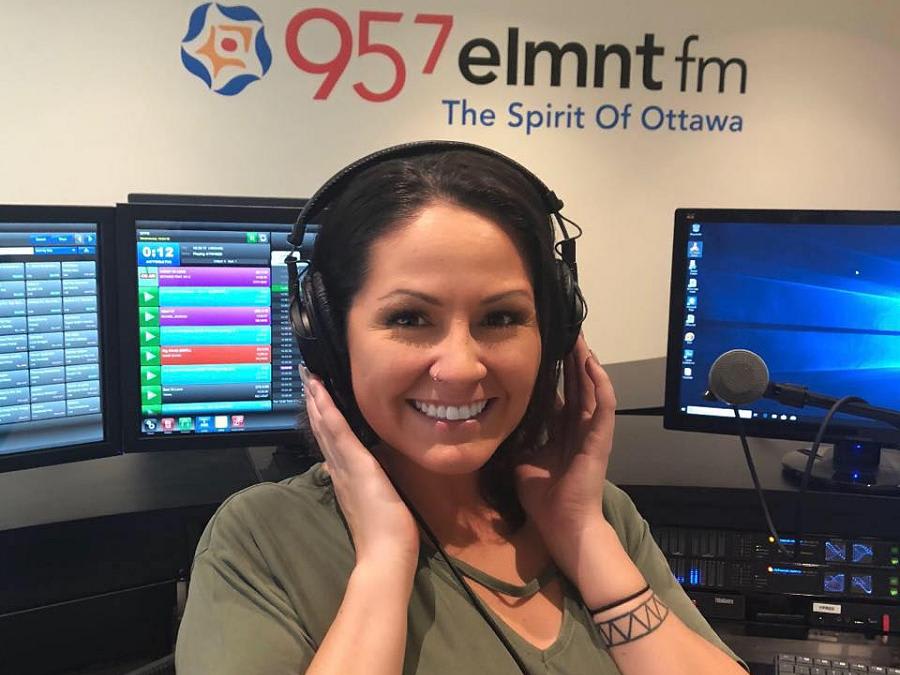
Missy Knott was one of the original Ottawa hosts at launch in 2018, but she had already left the station years earlier; a later profile says she worked there briefly before returning home in 2019
Bibliography
Andrianasolo, Laurent. “La culture Merina, base de la construction d’une culture nationale à travers les chansons diffusées par Radio Madagascar pendant la 1re République (1960–1972).” Kabaro, revue internationale des Sciences de l’Homme et des Sociétés, vol. 6–7, 2010, pp. 373–391. HAL Id: hal-03538430.
Canadian Radio-television and Telecommunications Commission. Broadcasting Notice of Consultation CRTC 2026-33: Call for Applications – Indigenous Radio Stations to Serve Ottawa and Toronto. 17 Feb. 2026, https://www.crtc.gc.ca/eng/archive/2026/2026-33.htm.
CBC News. “CRTC Calling for Indigenous-Led Radio Stations in Ottawa and Toronto.” CBC News, 23 Mar. 2026, https://www.cbc.ca/news/canada/ottawa/crtc-indigenous-radio-stations-ottawa-toronto-9.7137224.
APTN News. “First Peoples Radio Inc. Launches ELMNT FM in Toronto and Ottawa.” APTN News, https://www.aptn.ca/first-peoples-radio-inc-launches-elmnt-fm-in-toronto-and-ottawa/.
KawarthaNOW. “Missy Knott Launches Radio Career at New Indigenous Radio Station in Ottawa.” KawarthaNOW, 24 Oct. 2018, https://kawarthanow.com/2018/10/25/missy-knott-on-the-radio/.
Broadcast Dialogue. “First Peoples Radio Makes Layoffs.” Broadcast Dialogue, 13 Oct. 2022, https://broadcastdialogue.com/first-peoples-radio-makes-layoffs/.